


Last Updated: October 27, 2026
Quick Summary
To build a capsule wardrobe, start by auditing what you already own and tracking what you actually wear for two weeks, then define your lifestyle and style goals, and choose a cohesive color palette of two or three neutrals plus one or two accents. Buy only for the gaps your audit reveals, and use cost per wear to judge each purchase.
- Sort your closet into wears often, wears rarely, and never, then track your real habits for two weeks.
- Pick two or three neutral base colors and add one or two accent colors that coordinate on sight.
- A workable starting range is around 30 to 40 pieces per season, adjusted for climate and laundry habits.
- Cost per wear is price divided by expected wears; a $120 pair of jeans worn 200 times lands near $0.60 per wear.
- Treat any piece you cannot picture wearing at least 30 times as a want, not a core purchase.
Table of Contents
- What a Capsule Wardrobe Really Is (and What It Isn't)
- Why a Minimalist Wardrobe Pays Off in Time, Money, and Closet Space
- How to Build a Capsule Wardrobe for Beginners: Step by Step
- How Many Clothes in a Capsule Wardrobe? Finding Your Personal Number
- Capsule Wardrobe Essentials: The Versatile Pieces That Do the Most Work
- Your Capsule Wardrobe Checklist for a Complete, Wearable Closet
- Building a Budget and Cost-per-Wear Framework That Keeps You Honest
- Making It Yours: Inclusive Sizing, Climate, and Real-Life Constraints
- Care, Repair, and Longevity: Making the Capsule Last
- Shop Versatile Basics That Mix With What You Already Own
- Frequently Asked Questions
What a Capsule Wardrobe Really Is (and What It Isn't)
A capsule wardrobe is a small, curated collection of clothing pieces that all work together, so every item earns its place through frequent wear and easy mixing.
The confusion starts with the word "small." A capsule wardrobe is built around how to build a capsule wardrobe that fits your actual life, not a number someone posted online.
What it isn't: a seasonal shopping spree disguised as minimalism, or a rule that forbids color. A capsule is a system for making decisions faster.
Why a Minimalist Wardrobe Pays Off in Time, Money, and Closet Space
The payoff is simple: fewer decisions, less waste, more outfits from what you already own.
Many people find the biggest gain is mental, not financial. When every top works with every bottom, outfit combinations multiply without adding clothes.
There's a money angle too. Buying fewer, better pieces and wearing them repeatedly lowers your cost per wear over time. That's the quiet case for high-quality clothing over fast fashion: durability spreads the cost across years of use.
How to Build a Capsule Wardrobe for Beginners: Step by Step
Start with what you own, define your life and style, then choose a palette before you buy anything. That order matters. Most beginners shop first and plan later, which is exactly how closets fill up with pieces that don't combine.
Below is the three-step process we recommend. It takes an afternoon or two, and it saves far more time than it costs.
Step 1: Audit Your Closet and Track What You Actually Wear
Pull everything out and sort it into three piles: wears often, wears rarely, and never. Be honest about the "never" pile. If a piece hasn't been worn in a year, it's not part of your capsule, whatever you paid for it.
Then track for two weeks. A simple tally on your phone works. Note what you reach for on workdays, weekends, and evenings out. This is your real data, and it usually contradicts what you think you wear.
Declutter the never pile through donation or resale. What remains is your starting inventory, and it tells you your wardrobe gaps before you spend a dollar.
Step 2: Define Your Style, Lifestyle, and Wardrobe Goals
Write down how you spend your weeks. A corporate office job needs polished layers; a remote schedule leans casual. Your personal style should serve that reality, not an aspirational version of it.
Ask three questions: What do I want to look like on a normal Tuesday? What do I need for the events I actually attend? What do I want to stop buying? The answers set your wardrobe goals and keep you from curating a closet for a life you don't live.
Step 3: Choose a Cohesive Color Palette
Pick two or three neutral colors as your base, then add one or two accent colors you love. Neutrals might be navy, black, cream, and gray; accents could be olive, rust, or burgundy. The point is that everything coordinates on sight.
Test it before you buy: hold a new piece against three things you already own. If it works with all three, it belongs. If it works with none, it's a one-off, and one-offs are what capsules are designed to prevent.
How Many Clothes in a Capsule Wardrobe? Finding Your Personal Number
There is no universal number, and anyone who gives you one is guessing.
Here's a personalized method instead of a fixed count. Count how many days you go between laundry cycles, then multiply by the outfits you need for work and life.
| Lifestyle | Typical Piece Range | Why |
|---|---|---|
| Corporate office, weekly laundry | 35-45 | Polished layers, more work tops |
| Remote or hybrid | 25-35 | Casual basics, fewer structured pieces |
| Four-season climate | 40-50 | Layers and outerwear across seasons |
| Warm climate year-round | 20-30 | Lightweight tops, fewer layers |
Treat the number as a budget, not a cage. If you're constantly short on clean work tops, your count is wrong, not your discipline.
Capsule Wardrobe Essentials: The Versatile Pieces That Do the Most Work
The pieces that earn their keep are the ones that layer, transition, and repeat without looking repetitive. For most capsules, that means a few well-fitting tops, two or three bottoms, a layer or two, and shoes that work across occasions.
For women, a straight-leg jean can be a versatile option. Our RISEN full size straight leg jeans with pockets plus size come in a cotton-polyester-spandex blend with slight stretch, sized from S through 3XL, and pair as easily with sneakers as with heels.

For men, the basics carry the load. A white button-up handles interviews and dinners; our men's plus size button up long sleeve shirt in white is 100% cotton and machine washable. A neutral tee is the everyday layer, and our men's plus size round neck short sleeve tee is lightweight and breathable in a cotton-spandex blend.


These are versatile pieces to consider for your capsule.
Your Capsule Wardrobe Checklist for a Complete, Wearable Closet
Use this checklist to confirm your capsule is complete before you buy another thing. A complete capsule covers every occasion in your week, not every occasion imaginable.
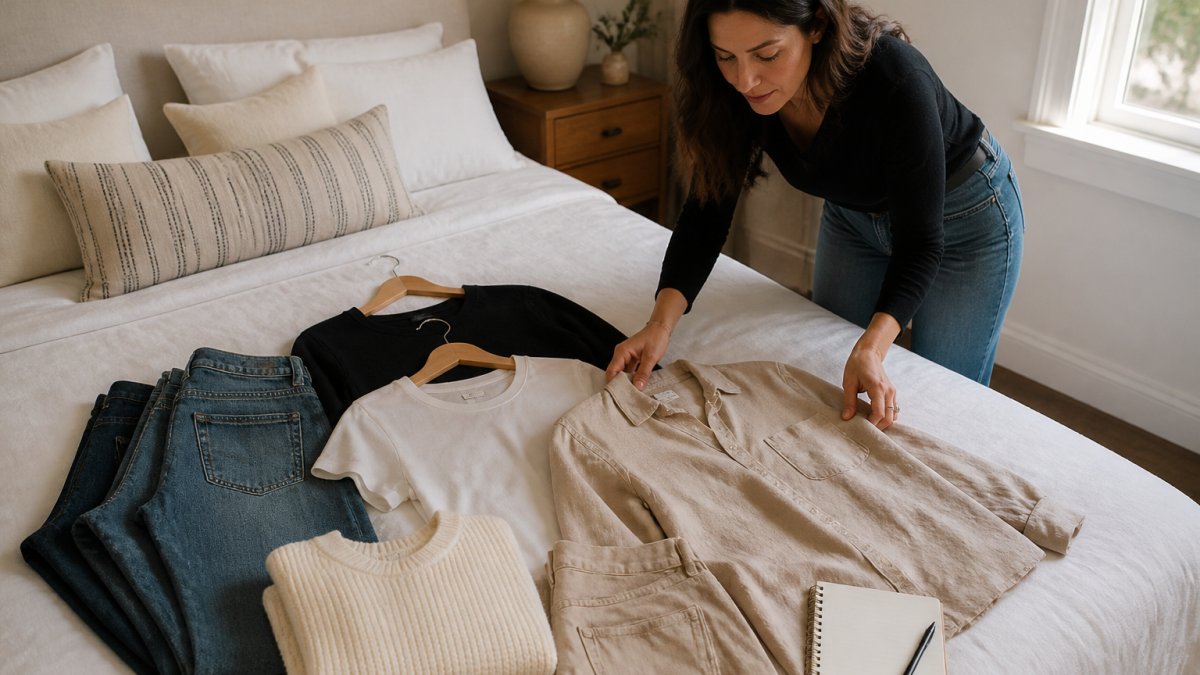
- Two or three bottoms that fit well and suit your dress code
- Four to six tops that mix with every bottom
- One or two layers for temperature and polish
Accessories can finish an outfit. A simple piece like our 2 piece 18k gold plated heart necklace adds polish.
RISEN Full Size Straight Leg Jeans with Pockets Plus Size →
Building a Budget and Cost-per-Wear Framework That Keeps You Honest
Most capsule guides tell you to "buy quality" and stop there. That advice is useless without a number. This section gives you a working budget and a cost-per-wear filter you can apply before you spend, not after.
Set the budget before you set the list
Start with an annual clothing number you can actually fund, then divide it into a seasonal allowance. A common pattern is to reserve roughly 70% of the annual figure for planned core purchases and hold 30% back for replacements and gaps you discover mid-season. Write the number down. A budget you keep in your head is a wish.
Then rank your gaps in this order:
- Fit failures, pieces you own but avoid because they pull, gap, or bind. Replacing these returns the most wears per dollar.
- Coverage gaps, occasions in your week with no outfit (a work layer, a weatherproof shoe).
- Upgrades, a worn-out workhorse you already wear weekly.
- Wants, everything else. These come last, and only if the budget allows.
The cost-per-wear filter, with real math
Cost per wear is price divided by the number of times you expect to wear a piece. Run it before you buy:
- A $120 pair of jeans worn twice a week for two years (about 200 wears) lands near $0.60 per wear.
- A $25 top worn three times costs about $8.33 per wear.
- A $90 blazer worn once a week for a year (about 50 wears) lands near $1.80 per wear.
The cheap top is the expensive purchase. This is the mechanism behind the "buy fewer, better" advice: durability and frequency are what drive the number down, not the sticker price alone.
Estimate wears honestly
Before you commit, answer three questions: How often per month will I realistically reach for this? Does it work with at least three pieces I already own? Does it survive my laundry routine? If the honest answer to the first question is "a few times a year," the cost per wear is high no matter how good the deal is.
Track it for one season
You do not need software. A note on your phone with two columns, item and estimated wears, is enough. After a season, compare estimates to reality. Most people find they overestimate wears on statement pieces and underestimate them on basics. Adjust your next budget with that data, and the framework gets sharper every season.
Making It Yours: Inclusive Sizing, Climate, and Real-Life Constraints
A capsule wardrobe only works if it fits your body, your weather, and your actual constraints. Generic checklists assume a body, a climate, and a schedule that most readers do not have. This section adapts the framework instead of asking you to adapt to it.
Fit first: build around your body, not a size label
Fit is the foundation, and it is not the same as size. Measure yourself once, bust or chest, waist, hip, inseam, and keep those numbers on your phone.
A few fit adaptations that matter across body types:
- Curvier hips and thighs: prioritize bottoms with stretch and a rise that sits at or above the natural waist; straight and bootcut legs balance proportion better than skinny cuts for many people.
- Broader shoulders or chest: look for dropped-shoulder seams and open necklines; they relax the line without sizing up the whole garment.
- Petite frames: hem length and rise do more for fit than any other measurement; a tailor can shorten a hem for a modest fee and it changes how a piece reads.
Age is not a rule, but priorities shift. Many people over 40 find they care more about fabric drape, ease of movement, and neckline comfort than trend details. Build for the body you have now, not the one in an old photo.
Gender expression: the framework is the same
The capsule structure, audit, palette, versatile basics, cost per wear, works regardless of how you dress. What changes is the item list. If your wardrobe mixes traditionally masculine and feminine pieces, build your palette and your fit rules around the silhouette you actually want to wear, and let the checklist follow. A button-up, a straight-leg bottom, a layer, and a shoe that works across occasions are universal building blocks; the cut and fit are yours to choose.
Climate rules that change the count
Climate does more to your piece count than personal preference does:
- Cold winters: you need real outerwear, not a fashion layer. Budget for one warm coat and one lighter jacket, and count base layers as tops.
- Hot, humid summers: breathable natural fibers and fewer layers; you will launder more often, so your count can be smaller.
- Four distinct seasons: the practical answer is two capsules that share a core, a warm-weather set and a cold-weather set, with the neutral basics carrying across both.
Real-life constraints are design inputs
Laundry access, dress codes, sensory preferences, and mobility needs are not obstacles to work around, they are inputs. If you do laundry weekly, your count can be lean. If you do it every two weeks, add pieces. If tags and seams bother you, cut them and prioritize soft, flat seams. If you need easy closures, build around them. A capsule that ignores these is a capsule you will abandon.
Care, Repair, and Longevity: Making the Capsule Last
Longevity is where a capsule earns its keep, and it comes down to care. Wash less often, follow the care label, and repair small damage before it spreads.
Start with the care instructions on each garment. Small habits can help you care for your clothing.
Shop Versatile Basics That Mix With What You Already Own
The final step is shopping with intention, and only for the gaps your audit revealed. You don't need a whole new wardrobe; you need a few versatile basics that work with what's already hanging in your closet.
Start with layers that stretch across seasons. A denim jacket is one option, and our distressed raw hem dropped shoulder denim jacket Our men's round neck long sleeve sweater is a listed sweater, and our men's zip up washed denim jacket
At LPGSundries, we curate denim, linen, and gold-plated jewelry designed for everyday wear, with free US shipping on orders over $100. Build slowly and choose pieces that fit your capsule.
Frequently Asked Questions
How do I start a capsule wardrobe from scratch?
Start with a closet audit before you buy anything. Pull out the pieces you wore in the last two weeks and set aside the rest. Then define your daily lifestyle (office, remote work, weekends) and pick a color palette built around two or three neutrals. From there, list the gaps and buy only those pieces. A capsule wardrobe for beginners works best when you add items gradually over a few months rather than replacing everything at once.
How many clothes should be in a capsule wardrobe?
There is no fixed rule, but most capsules land between 30 and 50 items including shoes and outerwear for a season. The 5-4-3-2-1 and 5-5-5 formulas are popular starting points, though they are guidelines rather than requirements. A more reliable method is to count how many tops, bottoms, and layers you need to cover a full week of outfits plus a few extras. If you do laundry weekly, a smaller count works fine.
What are the essential pieces for a capsule wardrobe?
Most capsule wardrobe essentials include two pairs of well-fitting jeans or trousers, three to five tops in neutral colors, one or two button-up shirts, a knit layer, a structured jacket, a dress or two if you wear them, and one pair each of everyday sneakers, flats, and boots. Add a few accent pieces and accessories. Choose durable materials and fits you can dress up or down, since versatility is what makes each piece earn its place.
How do I choose colors for a capsule wardrobe?
Pick two or three neutral base colors that match your existing wardrobe, such as black, navy, cream, gray, or denim blue. Then add one or two accent colors you genuinely enjoy wearing. Test each new piece against at least three items you already own. If it does not combine with anything, it does not belong in the capsule. This approach keeps outfit combinations high and impulse purchases low.
How often should I update my capsule wardrobe?
Review your capsule each season, roughly every three months, and replace only items that wore out or no longer fit. A full rebuild is rarely necessary. Track what you wore and what you skipped, then adjust the next season's list. You can rotate seasonal pieces in and out of storage.
Is a capsule wardrobe worth it if I work in a corporate office?
Yes. You can build around the dress code. Build around polished basics: straight-leg trousers or dark jeans, button-up shirts, a knit layer, and a structured jacket in neutral colors. Keep the casual pieces for weekends. A capsule wardrobe checklist for work can include mix-and-match outfits.
The hardest part of a capsule wardrobe isn't the planning; it's trusting a smaller closet to cover your life. Start with an audit, choose a palette, and add pieces only where the gaps are real. LPGSundries can help with hand-selected denim, linen, and gold-plated accessories built for daily wear, backed by free US shipping on orders over $100. Get started with LPGSundries and build a closet where every piece earns its place.
